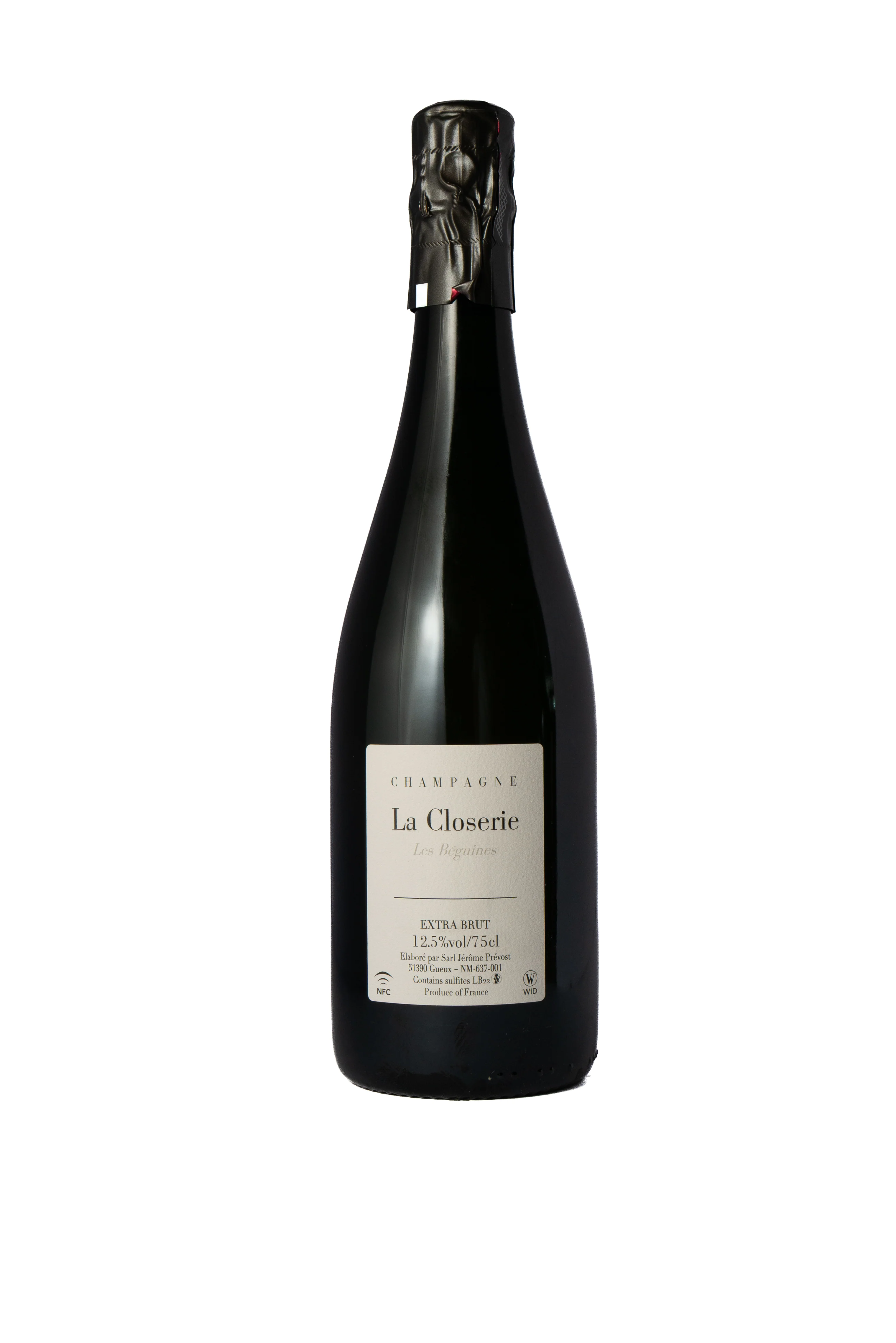
Jerome Prevost La Closerie 'Les Beguines' Champagne
- ABOUT THE WINE: (Base 23, Disg. Sep 2025). This is 2023 base with 20% reserve wine. Prévost’s 2.2-hectare vineyard, Les Béguines, is in Gueux, 10km west of Reims in the north of Champagne. The soil here is a layer cake of calcareous (Thanetian) sand over clay, over more calcareous sand. Inherited from Jérôme’s grandmother, the site was planted in the 1960s with an old, slow-growing, rootstock that descends deep. Les Béguines is close to 100% Meunier, although there is now a small parcel of 10-year-old Chardonnay, Pinot Noir and Pinot Blanc (these vines represent roughly six per cent of the blend). The vineyard is managed organically, with the soils cultivated exclusively by horse and the yields kept in balance. As always, the wine was vinified without any additions, in large-format, used barrels, for 10 months, and was bottled unfiltered. In the past, this was always a tightly wound wine that needed a number of years to open. Now, with the warmer climate and evolution in farming and winemaking—including the addition of reserve wine—it’s another world. The wines are much more approachable from an early age, and the 2023 base is no exception. This is much richer and more layered than the wine above, and already drinking well. Loads of fleshy, pear, stone fruit and honey-noted depth—there’s also plenty of spice and a lovely powdery close. A super release of this unique wine.
-
ABOUT THE PRODUCER: Jérôme Prévost is a micro grower-producer based in the picture-perfect village of Gueux, on the edge of the Montagne de Reims or what the locals call la Petite Montagne. Here, in the northwest of Champagne, he grows a tiny quantity of remarkable, ageworthy Meunier from a single, two-hectare plot of 40-year-old vines. His wines have garnered a cult following across the globe and are sold strictly on allocation. Peter Liem gives you an idea of the current frenzy for Prévost’s wines: “It’s virtually impossible to be a hip wine bar or wine store in Paris, or, indeed, anywhere if you don’t have champagne from Jérôme Prévost ...Selling a Prévost wine, or ordering one at a wine bar or restaurant has become almost a badge of honor, a secret sign that affirms your initiation into an exclusive club of those in the know. Unfortunately, with an annual production of only 13,000 bottles, Prevost’s wine is not always easy to obtain.” The Prévost story is a long one. Let’s simplify it and simply say he inherited a vineyard from his grandmother and that his friend Anselme Selosse encouraged and helped him to make wine from this parcel. His first vintage was 1998. Selosse let Prévost use his winery until 2003, after which Prévost began making wine in the garage at the rear of his home in Gueux. Prévost’s vines were planted in the ‘60s before what Prévost calls the “great industrial revolution in Champagne”. This was before mechanisation, chemicals and clones became the norm. For this reason, the vines were planted with a good rootstock based on quality rather than yield. It’s a rootstock that plunges deep but takes far longer to grow above the ground, the opposite of what producers were looking for post-’70s. Prévost’s initial idea was to produce one wine each year from one vineyard (les Béguines), one grape variety (Meunier) and one vintage. Sometimes, Prévost also bottles a small amount of rosé. This has evolved over time, mainly thanks to the treacherous nature of his frost-prone terroir. The domaine’s devastating losses in 2017 prompted him to pivot from RM status (estate-only fruit) to NM (estate and purchased fruit) in order to make sustainable levels of wine. Prévost managed to secure some fruit from his neighbour’s vines in Les Béguines, along with some other parcels in Gueux, all on the same soils as the estate vines. The wine from these new sources is simply called La Closerie and carries a striking red ampersand motif on the label. The wines of Jérôme Prévost are as complex and intriguing as the man himself. So, how to sum them up in a few words? Tasting notes are useless as the wines shift, turn and evolve. What we can say in general terms is that they are dry, vinous, aromatic, floral, spicy wines with huge energy, drive and longevity. They are textured yet tightly wound. They are wildly complex, never boring, and great with food. They also benefit enormously from time (1-5 years) in the cellar. Bibendum
- COUNTRY: France
- REGION: Champagne
- SUB-REGION: Montagne de Reims
- VARIETAL: Pinot Meunier
- WINE STYLE: Sparkling Wine
- WINEMAKER: Jerome Prevost
- CLASSIFICATION: Organic farming
- CLOSURE: Cork
- ABV%: 12.5%
- SIZE: 750ml
Original: $384.79
-65%$384.79
$134.68Product Information
Product Information
Shipping & Returns
Shipping & Returns
Description
- ABOUT THE WINE: (Base 23, Disg. Sep 2025). This is 2023 base with 20% reserve wine. Prévost’s 2.2-hectare vineyard, Les Béguines, is in Gueux, 10km west of Reims in the north of Champagne. The soil here is a layer cake of calcareous (Thanetian) sand over clay, over more calcareous sand. Inherited from Jérôme’s grandmother, the site was planted in the 1960s with an old, slow-growing, rootstock that descends deep. Les Béguines is close to 100% Meunier, although there is now a small parcel of 10-year-old Chardonnay, Pinot Noir and Pinot Blanc (these vines represent roughly six per cent of the blend). The vineyard is managed organically, with the soils cultivated exclusively by horse and the yields kept in balance. As always, the wine was vinified without any additions, in large-format, used barrels, for 10 months, and was bottled unfiltered. In the past, this was always a tightly wound wine that needed a number of years to open. Now, with the warmer climate and evolution in farming and winemaking—including the addition of reserve wine—it’s another world. The wines are much more approachable from an early age, and the 2023 base is no exception. This is much richer and more layered than the wine above, and already drinking well. Loads of fleshy, pear, stone fruit and honey-noted depth—there’s also plenty of spice and a lovely powdery close. A super release of this unique wine.
-
ABOUT THE PRODUCER: Jérôme Prévost is a micro grower-producer based in the picture-perfect village of Gueux, on the edge of the Montagne de Reims or what the locals call la Petite Montagne. Here, in the northwest of Champagne, he grows a tiny quantity of remarkable, ageworthy Meunier from a single, two-hectare plot of 40-year-old vines. His wines have garnered a cult following across the globe and are sold strictly on allocation. Peter Liem gives you an idea of the current frenzy for Prévost’s wines: “It’s virtually impossible to be a hip wine bar or wine store in Paris, or, indeed, anywhere if you don’t have champagne from Jérôme Prévost ...Selling a Prévost wine, or ordering one at a wine bar or restaurant has become almost a badge of honor, a secret sign that affirms your initiation into an exclusive club of those in the know. Unfortunately, with an annual production of only 13,000 bottles, Prevost’s wine is not always easy to obtain.” The Prévost story is a long one. Let’s simplify it and simply say he inherited a vineyard from his grandmother and that his friend Anselme Selosse encouraged and helped him to make wine from this parcel. His first vintage was 1998. Selosse let Prévost use his winery until 2003, after which Prévost began making wine in the garage at the rear of his home in Gueux. Prévost’s vines were planted in the ‘60s before what Prévost calls the “great industrial revolution in Champagne”. This was before mechanisation, chemicals and clones became the norm. For this reason, the vines were planted with a good rootstock based on quality rather than yield. It’s a rootstock that plunges deep but takes far longer to grow above the ground, the opposite of what producers were looking for post-’70s. Prévost’s initial idea was to produce one wine each year from one vineyard (les Béguines), one grape variety (Meunier) and one vintage. Sometimes, Prévost also bottles a small amount of rosé. This has evolved over time, mainly thanks to the treacherous nature of his frost-prone terroir. The domaine’s devastating losses in 2017 prompted him to pivot from RM status (estate-only fruit) to NM (estate and purchased fruit) in order to make sustainable levels of wine. Prévost managed to secure some fruit from his neighbour’s vines in Les Béguines, along with some other parcels in Gueux, all on the same soils as the estate vines. The wine from these new sources is simply called La Closerie and carries a striking red ampersand motif on the label. The wines of Jérôme Prévost are as complex and intriguing as the man himself. So, how to sum them up in a few words? Tasting notes are useless as the wines shift, turn and evolve. What we can say in general terms is that they are dry, vinous, aromatic, floral, spicy wines with huge energy, drive and longevity. They are textured yet tightly wound. They are wildly complex, never boring, and great with food. They also benefit enormously from time (1-5 years) in the cellar. Bibendum
- COUNTRY: France
- REGION: Champagne
- SUB-REGION: Montagne de Reims
- VARIETAL: Pinot Meunier
- WINE STYLE: Sparkling Wine
- WINEMAKER: Jerome Prevost
- CLASSIFICATION: Organic farming
- CLOSURE: Cork
- ABV%: 12.5%
- SIZE: 750ml